Description
Mindstage delivers a pre-recorded lecture inside a virtual lecture space. A virtual three-dimensional space was created specially as a performance space for the selected lecture. The topic of the talk defines the environment and the spatial arrangement of its illustrative elements and the argument of the talk drives the design of the space. A pre-coded lecturer avatar guides students through the virtual world, moving from one object/ illustration/ film clip to another while delivering the lecture.The lecture chosen for the prototype is the Film Design: Illusion and Practice lecture on film design delivered by the award-winning film designer Christopher Hobbs whose film credits include Caravaggio, Edward II (Jarman 1986, 1991), The Long Day Closes (Davies 1992), Velvet Goldmine (Haynes 1998) and on television Cold Lazarus(1994) and Gormenghast (2000). His lecture entitled Film Design: Illusion and Practice talks about these, and the wide range of precedents (from the Bride of Frankenstein to Blade Runner) that he admits as influences. The lecture is richly illustrated with film clips and production stills.
Within the virtual world, Christopher Hobbs is represented as a virtual avatar figure: an ancient Aztek mask. The mask character presents the talk while moving on a chosen predetermined path through the lecture-space. Comparable to a 'Memory Palace' Mindstage creates spatial mirrorworlds of the lecturer's line of thoughts.
Certain rooms contain ingredients of certain logical arguments, proofs, or scientific enigmas the speaker mentions during the talk. The speaker explores this themed virtual world and its ingredients parallel to the unfolding of the logical argument. The lecture is not treated solely as an information delivery to students but also as a narrative through the topic that has been translated into a spatial journey.
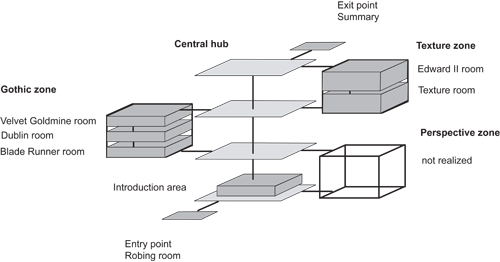
A student can access this data via an Internet download or through an educational CD-ROM. 'Logging on' to a specific lecture will create a student avatar on the Mindstage and allow the student to follow the lecturer's line of thought by spatially following the lecturer. Thus, the student becomes immersed in the content of the lecture by exploring the thought process of the speaker.
Various interactive features are available during the lecturer's linear presentation and the individual exploration of the Mindstage space: control over film clips, over 3D objects (elevators, 3D puzzles), and a text chat feature. In addition we experiment with tracing the spatial movement and the chat-behavior in the lecture space for evaluation purposes.